Should Luzerne County Sellers Get a Pre-Listing Inspection Before Going Live?

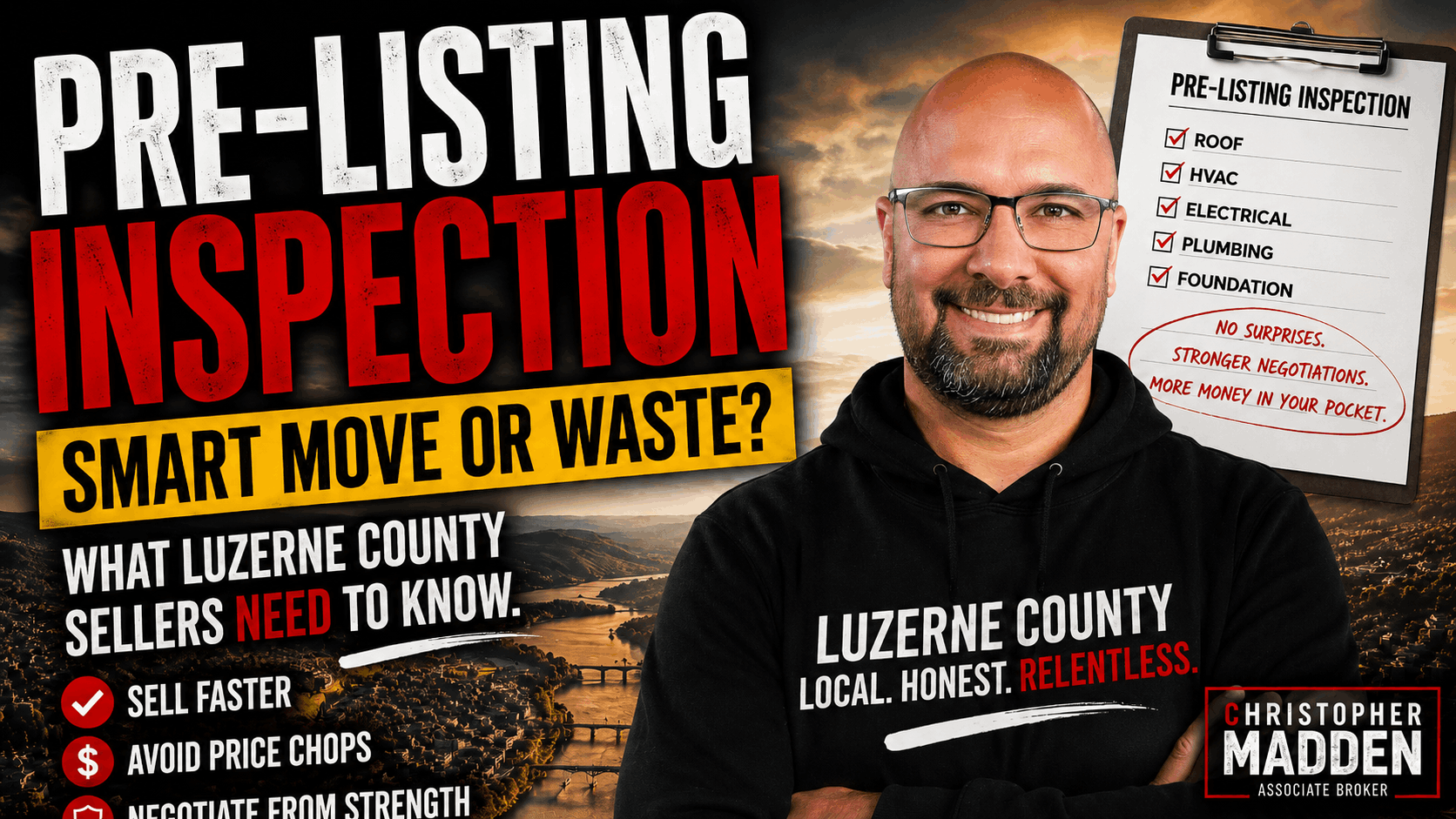
Yes—most Luzerne County sellers should get a pre-listing inspection before the home hits the market, especially if the house is older, has a basement, roof concerns, DIY work, septic/well issues, or deferred maintenance. The goal is not perfection. It is controlling the negotiation before a buyer uses defects against you.
Why does a pre-listing inspection matter so much in Luzerne County?
Luzerne County is not a cookie-cutter new-construction market. You have older homes in Wilkes-Barre, Kingston, Nanticoke, Pittston, Plymouth, Hazleton, and Forty Fort. You have rural properties around Mountain Top, Dallas, Back Mountain, Wapwallopen, and Hunlock Creek with wells, septic, acreage, drainage, old electrical, old roofs, and basements that may or may not behave.
That matters because inspection issues are where seller leverage gets ugly.
As of spring 2026, Luzerne County was still moving, but not every seller was getting a clean over-asking feeding frenzy. Zillow reported a typical Luzerne County home value of $219,502, homes going pending in about 20 days, and 60.4% of sales under list price as of March 2026.
Redfin reported a $224,000 median sale price in March 2026, up 14.9% year-over-year, but also showed homes taking 37 days on market versus 30 days the year before.
That means this is not the market for lazy listing prep. Buyers still care about condition. Lenders still care about safety. Appraisers still exist. And buyer agents will absolutely use a bad inspection report as a crowbar if you hand them one.
What does a pre-listing inspection actually do for a seller?
A pre-listing inspection gives the seller information before the buyer gets it.
That is the whole point.
It identifies the obvious deal-killers before showings, before offers, before emotions, and before a buyer has the property tied up under contract. Pennsylvania defines a home inspection as a noninvasive visual examination of major systems and structural components designed to identify material defects in connection with a possible residential real estate transfer.
A good pre-listing inspection can help a seller:
- Fix safety or financing issues before listing.
- Price the home with fewer blind spots.
- Update the seller disclosure honestly.
- Reduce post-offer repair demands.
- Avoid going back on market after a failed inspection.
- Give serious buyers more confidence before they write.
This is not about making the house perfect. Perfect is usually expensive and unnecessary.
This is about not getting ambushed.
How much money can a pre-listing inspection protect?
A standard Pennsylvania home inspection often falls around $350 to $550 for a single-family home, depending on size, age, and add-on testing.
In my listing strategy, that cost is often cheap compared with what happens when a buyer finds a roof issue, moisture problem, electrical defect, mold concern, or structural question after the house is already under contract. Christopher’s documented listing approach treats pre-listing inspections as a major seller-side differentiator because they can preserve roughly $5,000 to $10,000 or more by reducing buyer negotiation power before it starts.
| Seller choice | Typical cost | Main risk | Better use case |
|---|---|---|---|
| Skip inspection | $0 upfront | Buyer finds problem later and renegotiates hard | Very clean newer home with strong records |
| Pre-listing inspection | Often $350–$550 | You must deal with known defects honestly | Most older Luzerne County homes |
| Wait for buyer inspection | $0 upfront | Surprise repairs, credits, delay, termination | Seller has high risk tolerance |
| Repair everything blindly | Can be thousands | Wasted money on low-ROI work | Rarely the right first move |
What is the blunt seller mistake I see all the time?
Sellers spend money on the wrong things.
They paint the kitchen, change light fixtures, or obsess over cosmetic nonsense while ignoring the attic, basement, roof, electrical panel, furnace, moisture, or foundation. That is backwards.
A buyer is not usually killing a deal because your kitchen color is boring. They kill deals because the inspection says there is mold in the attic, water in the basement, knob-and-tube wiring, a failing roof, bad grading, or a furnace held together by hope and old service stickers.
“A pre-listing inspection is not about being nice to the buyer. It is about taking away their best weapon before they get to use it. If I know the problem first, I can help the seller decide whether to fix it, disclose it, price around it, or negotiate from strength.”
— Christopher Madden, Associate Broker
What are Pennsylvania sellers legally required to disclose?
Pennsylvania sellers must disclose known material defects by completing the applicable property disclosure statement before the buyer signs an agreement of transfer.
A “material defect” generally means a property problem that would significantly hurt the property’s value or create an unreasonable risk to people on the property.
Pennsylvania’s disclosure form covers categories like the roof, basement and crawl spaces, termites or wood-destroying insects, structural problems, water and sewage systems, plumbing, HVAC, electrical, drainage, hazardous substances, and legal issues affecting use of the property.
Here is the part sellers need to understand: Pennsylvania law does not require a seller to conduct a specific investigation just to complete the disclosure, but the seller cannot make false, deceptive, or misleading statements and cannot fail to disclose a known material defect.
Translation: once you know, you know.
Can a pre-listing inspection hurt the seller?
Yes, if the seller is the kind of person who wants to hide problems.
That is not a strategy. That is how people end up with legal problems, dead deals, and angry buyers.
The Pennsylvania Association of Realtors has warned that when a seller has knowledge from an inspection report, the seller’s key obligation is to make sure known material defects are updated and provided to the buyer. PAR also notes that buyers do not automatically have a legal right to demand prior inspection reports, but known material defects still need to be disclosed.
So yes, a pre-listing inspection can create disclosure obligations.
Good.
I would rather deal with the truth before the listing goes live than have a buyer discover it three weeks later when everyone is already stressed, packed, emotionally invested, and acting irrational.
Which Luzerne County sellers should strongly consider a pre-listing inspection?
You should strongly consider one if any of these apply:
- Your home is more than 20 years old.
- You have a basement or crawl space.
- You have had water, mold, grading, or drainage issues.
- The roof is older or has unknown age.
- The home has well, septic, oil heat, older electrical, or older plumbing.
- You inherited the property and do not know its full history.
- You own a rental and have not personally lived there.
- You want to list aggressively and reduce buyer objections.
- You are selling in a price band where buyers are payment-sensitive.
This applies to a lot of Luzerne County housing stock.
A 1950s home in Kingston, a raised ranch in Mountain Top, a duplex in Wilkes-Barre, a farmhouse near Wapwallopen, and a long-owned ranch in Dallas all have different risk profiles. That is why generic advice is useless.
When might a pre-listing inspection not be necessary?
A pre-listing inspection may not be necessary if the property is newer, recently inspected, well-documented, lightly used, and has no obvious system concerns.
It may also be less useful if the seller is intentionally selling to an investor, pricing the home heavily as-is, and already expects condition-based discounting.
But “as-is” does not magically erase disclosure obligations. If you know about a material defect, you still need to handle that correctly. Pennsylvania law is clear that known material defects matter.
Should sellers fix everything before listing?
No.
Fixing everything is usually dumb.
The better question is: Which defects will cost more later if we do nothing now?
| Issue type | Usually fix before listing? | Why? |
|---|---|---|
| Active leak | Yes | Buyers punish uncertainty hard |
| Mold-like attic growth | Usually yes | Creates fear and renegotiation |
| Missing GFCI / minor electrical | Often yes | Cheap fix, annoying objection |
| Old but working furnace | Maybe not | Disclose age; replacement may not return cost |
| Cosmetic paint | Maybe | Only if it changes buyer perception cheaply |
| Full kitchen remodel | Usually no | Cost often exceeds seller return |
| Roof near end of life | Depends | May need quote, credit strategy, or pricing adjustment |
The inspection is not the plan.
The inspection gives you the information to build the plan.
How should a seller use the inspection report strategically?
There are four basic options after a pre-listing inspection:
- Fix the problem before listing.
Best for safety, financing, moisture, and obvious buyer panic items. - Disclose the issue and price accordingly.
Best when the repair is expensive but the home is still marketable. - Get contractor estimates before listing.
Best when buyers will overestimate the repair cost. - Do nothing, but prepare the negotiation strategy.
Best for minor items or defects that are already obvious.
This is where a lot of agents screw it up. They either tell sellers to fix everything, or they ignore everything and hope the buyer does not notice.
Hope is not a listing strategy.
Will buyers still do their own inspection?
Some will. Some should.
A pre-listing inspection does not eliminate a buyer’s right to do their own due diligence unless the buyer chooses otherwise in the agreement.
But it changes the tone. Instead of the buyer discovering the issue and acting like they found buried treasure, the seller can say: “We already know. It was disclosed. Here is what we did, here is the quote, or here is how the price reflects it.”
That is a very different negotiation.
What is the best timing for a pre-listing inspection?
Ideally, do it 2 to 4 weeks before listing.
That gives enough time to review the report, update disclosures, get contractor quotes, fix the smart items, and avoid delaying photography, video, showings, and launch timing.
For a seller trying to hit a specific window—spring market, relocation, estate sale, divorce timeline, school-year move, or downsizing schedule—waiting until after the buyer inspection is asking for chaos.
What is my final answer for Luzerne County sellers?
Yes, most Luzerne County sellers should get a pre-listing inspection before going live.
Not because every house is a disaster.
Because every house has risk, and risk is expensive when the buyer controls the timing.
A pre-listing inspection helps the seller control the story, control the prep, control the disclosure, and control the negotiation. That is the job.
What else do Luzerne County sellers ask about pre-listing inspections?
Is a pre-listing inspection required in Pennsylvania?
No. A pre-listing inspection is not legally required in Pennsylvania. But Pennsylvania sellers are required to disclose known material defects. A pre-listing inspection is a strategy decision, not a legal requirement. It helps sellers find problems early and decide how to handle them before buyers use them to renegotiate.
Do I have to give buyers the full pre-listing inspection report?
Not automatically. According to the Pennsylvania Association of Realtors, buyers do not have a legal right to demand prior inspection reports prepared for others. But sellers must update and disclose known material defects. Many sellers choose to share some or all of the report strategically, depending on the situation.
Can a pre-listing inspection lower my sale price?
It can expose issues that affect pricing, but that is not the same as lowering your value. The issue already existed. The inspection just found it before the buyer did. That gives the seller more control over repairs, pricing, disclosure, and negotiation.
Should I test for radon, mold, septic, or termites too?
Maybe. A standard home inspection is not the same as every specialized test. In Luzerne County, radon, pest, well, septic, mold, and sewer-related concerns may need separate testing depending on the property. Older homes, rural homes, and homes with moisture history deserve extra attention.
Should I renovate before getting a pre-listing inspection?
Usually no. Get the inspection first. Do not spend thousands guessing. A seller may think the kitchen needs paint, but the inspection may show the attic, roof, basement, or electrical panel is the real problem. Fixing the wrong thing is how sellers waste money.
Categories
Recent Posts